Any and every good server will be able to immediately sum up what kind of tipper you are based on a few basic points, such as age, race, tab, what your drinking, what your eating, how you are dressed, who you are with, etc. All of these factors total to a pretty good idea as to what to expect. Then as a server we know if the steak was over cooked, if something went wrong, if your glass went empty, if we screwed up, all of which can effect the tip. Remember that often times if you order a steak well done, it's going to take some time to prepare. Also, remember that many times a food mistake may or may not be the server's fault, it's hard to say.
Occasionally, we are surprised by the individual that tips more than expected or the jerk that stiffs us, but for the most part it's nothing new. Does this mean that most server's profile clients? Absolutely. I cannot say who the best tippers are, nor can I say who the worst tippers are, it all depends on the server. I can speak to my own experiences and tell you that in my experience age makes more of a difference than anything else. An 18 year old college kid taking his girl out for dinner is less likely to tip as well as a 54 year old professor, but it is possible that the kid wants to impress his girl by leaving a nice tip, you never know. As a young white male I find the best tippers to be older female ladies. I suppose I have a grandchild's charm about me. The most difficult guests I tend to deal with suprizingly enough are people in my same category, young males. I don't watch sports, I don't have time for t.v. shows, and I don't play the latest video games, I know very little about what people like me do, I just know my restaurant industry.
There is no other industry where the employee's are dependent on the kindness of strangers to pay thier living wage. Remember to tip your server, 20% at a minimum, if you are a doctor tip more... Don't ask me to split a $100 dollar bill on a $30 dollar order then give me two bucks, I know you have money.
Tales from the Front Lines:
Best Tip:
The best tip, (neither percentage nor dollar value, but the one I feel was the best), was from an older white man. I was working as a server in a common chicken finger style restaurant (Applebee's, Chili's, Buffalo Wild Wings, etc.) and two older couples came in and sat at a booth. I took their order, nothing spectacular, then I brough out the one man's steak. He cut into it, had a few bites, then explained that it wasn't medium rare like he ordered it. I apologized, took it back to the kitchen and had them remake it. I returned the steak to the man, he said it was perfect, but I still feared for the worst. His ticket came to roughly $50, and to my suprize he left me $30! Even after the kitchen had screwed up his order he left me well over 50%! I was astonished. Like I said, there have been times when I have made more than 50% and there are times when I have made more than 30 dollars off of a single order, but none quite compare to this man and his experience with the steak. The best tip in my opinion!
Worst Tip:
People love this story. It was half way through a dinner rush, when to my suprize I am approached by a manager, "Hey so-and-so didn't show up, but I sat a group at tables 1, 2, and 3, will you take them?" Oh boy. Tables 1, 2, and 3, is the worst section in the house, someone else didn't show, I've already got tables 5, 6, and 7 filled, and on top of that these people have been waiting for who knows how long for so-and-so to show up, but now I get to deal with them. It was a group of 10 African-Americans, all varying in age, but most in the 30's. I get their order (it's an appetizer, entree, desert special all around). I get everything out, then around the time I get the entrees passed out an 11th member shows up. I deal with them. Then when everyone is working on desert (guy 11 is working on his entree) 2 more people show up, bringing my total to 13 people! Evidently it is guy #13's birthday so as all 10 people sit and wait for the last couple to finish eating their app, entree, and desert as I gather up birthday singers. We sing, the group that wasn't even in my section to begin with, who have sucked up nearly 3 hours of my time, (time spent away from my original tables), their bill comes to in the neighborhood of $250. I thought to myself, AT the BARE MINIMUM of ONLY 10% I am going to make $25 dollars off this headache. It's important at this point to mention that at this location we tipped out our bussers and bartenders 3% of total sales (So, on this ticket $7.50 to everyone else but me). I made a whopping....
$8.00
I made $8.00 in 3 hours off of 13 people, $7.50 of which I was required to tip out. I made fifty cents in over three hours. At a servers rate of three dollars, I made $3.16 for half my shift. I should have made closer to $50 off the table... Unbelievable.
The Restaurant

Formal Dining
Friday, May 27, 2011

Thursday, May 26, 2011
Getting a Job in a Restaurant: ServSafe Certificate
This is going to sound like a shameless plug for a company paying me tons of money, but unfortunately for me it is not. I am sending this message out free of charge with no expectation of payment. That being said, the single most impressive thing you can write on your resume (as long as it's true) is that you are ServSafe Sanitation Certified. http://www.servsafe.com/
ServSafe is a nationally recognized company that teaches safe food handling procedures. They will go over everything, usually in an 8 hour class on Saturday, followed by an exam. Some community colleges offer ServSafe classes if there is a culinary program.
Some of the things you will go over include:
ServSafe is a nationally recognized company that teaches safe food handling procedures. They will go over everything, usually in an 8 hour class on Saturday, followed by an exam. Some community colleges offer ServSafe classes if there is a culinary program.
Some of the things you will go over include:
- Food temperature Danger Zone
- Ideal conditions for bacteria growth: Food, Acidity, Time, Temperature, Oxygen, Moisture
- Food borne illnesses, symptoms, and common causes
- HACCP plans
- Dishwashing basics
- Handwashing basics
- etc. etc.
Wednesday, May 25, 2011
Job Profiles: Host/Hostess
There are literally dozens of careers within the hospitality industry. This blog primarily focuses on the restaurant industry. What's the difference? Hospitality industry includes restaurants, hotels, country clubs, caterers/banquets, casinos, and cruise ships. The list goes on and on, but today we are looking at the restaurant.
I hope to explore the various positions in a restaurant one at a time. This is the first blog on this subject so far, so we are starting at the beginning. The first person you see when you walk into a restaurant is the host or hostess. In some restaurants this person is call the maitre d'hotel or maitre d. Some restaurants do not have a host, servers simply "self-host" or this position is filled by a manager type.
Some hosts are young, probably their first job others are the most experienced server in the building. Every restaurant is different, as such the responsibilities of the host will be different. In example, some hosts are required to bus tables as well as clean the bathroom, many do not. Being a host can be hard work especially if servers are always bugging you for tables, too many tables, mad people in line, or drunks trying to get in (earlier we learned to refuse entry to someone intoxicated).
Job Description
The primary job functions include seating guests as the arrive, keeping rotation of the servers, general cleaning duties (clean menus, floors, doors, windows, waiting area, etc.), taking reservations, present menus/coasters/silverware, alerting servers when they get sat, opening and holding the doors for guests as they enter and exit. Some hosts might change menu cards (specials, inserts, etc.), write the specials on a dry erase or chalk board, clean the bathrooms, bus server's dirty tables, run food, plus a mirade of other possible activities.
Pay Range
The job is often times overlooked, but any server will tell you when a host double or triple seats you, it puts you in the weeds almost immediately. Expected salary for this job, also varies quite a bit, but you can expect to be paid $7.25 to $10.00 plus a tip out from the servers. The tip out varies just like everything else, but the standard seems to be 1% of your total sales.
The Best Qualities
Depending on your goals, dreams, laws, etc. the next step can be in any of the three primary areas of a restaurant: Front-of-house as a server, back-of-house as expo/utility/dish, or to the bar as a bar back.
I hope to explore the various positions in a restaurant one at a time. This is the first blog on this subject so far, so we are starting at the beginning. The first person you see when you walk into a restaurant is the host or hostess. In some restaurants this person is call the maitre d'hotel or maitre d. Some restaurants do not have a host, servers simply "self-host" or this position is filled by a manager type.
Some hosts are young, probably their first job others are the most experienced server in the building. Every restaurant is different, as such the responsibilities of the host will be different. In example, some hosts are required to bus tables as well as clean the bathroom, many do not. Being a host can be hard work especially if servers are always bugging you for tables, too many tables, mad people in line, or drunks trying to get in (earlier we learned to refuse entry to someone intoxicated).
Job Description
The primary job functions include seating guests as the arrive, keeping rotation of the servers, general cleaning duties (clean menus, floors, doors, windows, waiting area, etc.), taking reservations, present menus/coasters/silverware, alerting servers when they get sat, opening and holding the doors for guests as they enter and exit. Some hosts might change menu cards (specials, inserts, etc.), write the specials on a dry erase or chalk board, clean the bathrooms, bus server's dirty tables, run food, plus a mirade of other possible activities.
Pay Range
The job is often times overlooked, but any server will tell you when a host double or triple seats you, it puts you in the weeds almost immediately. Expected salary for this job, also varies quite a bit, but you can expect to be paid $7.25 to $10.00 plus a tip out from the servers. The tip out varies just like everything else, but the standard seems to be 1% of your total sales.
The Best Qualities
- Good memory, useful to know when you just sat someone, which tables are clear, which are occupied, and which need bussed.
- Very good customer service skills, to deal with people waiting too long, upset people as they leave, and general interactions with the public
- Planning skills are necessary to know how long it will take a table to finish and where to seat the next group.
Depending on your goals, dreams, laws, etc. the next step can be in any of the three primary areas of a restaurant: Front-of-house as a server, back-of-house as expo/utility/dish, or to the bar as a bar back.
Monday, May 23, 2011
Getting A Job in the Restaurant: Your First Shift
This post is about starting your first day in a restaurant. Hopefully, they have told you what to wear or have provided you with your uniform. If they haven't provided you with a uniform then it may be the first thing they do. If they don't tell you what to wear and don't provide you with a uniform, use common sense and wear clothing similar to everyone else's. You may not have a Sonic uniform, but a red polo and black pants are easy to come by.
If you haven't already you will sit down and fill out your I-9 and W-2 information. Be sure to bring your driver's license. social security card. and a pen, if you haven't done this yet. You may also spend some time reviewing a policy manual/company handbook.
It's very common for a manager to pair you up with a seasoned employee. This style of training is called the "magic apron", because the manager assigns you to an "apron", another employee, and "magically" you learn how to do your job. Occassionally, some places will have you read through training material, or have you watch a short video or series of videos, but that is uncommon. You'll be more likely to see it in a restaurant chain, like McDonald's or Burger King.
Occassionally, the restaurant is in such dire situations that you are thrown in to learn as you go, so it's probably a good idea to be familiar with the menu before you start. Remember to stay calm and ask a lot of questions. You should ask about the menu. Examples: Is there anything on the menu we don't have?, Can I substitute things?, What is the vegetable/soup of the day?. Spend any down time you have looking over the store to figure out where things are supposed to go. For brownie points with management take a towel and wipe down things as you look at them. This will help you remember where things are. Physically touching an item and saying to yourself "I wiped down the credit card machine" will allow you to really remember where it is.
If you've never worked in a restaurant before, you'll soon discover how fast paced and busy it can get followed by breaks with no customers in the store. It's important to stay focused when you are busy and keep moving when you are slow. Nothing will make manager's or owner's more upset if they see an employee standing around doing nothing. "If you've got time to lean, you've got time to clean," is a common phrase you'll probably hear.
On your first day you should try to absorb everything like a sponge. Make sure you really focus on your job. If you're hired as a cook don't worry about the expo guy, just being a cook. It's best to learn the proper way to do any particular task because most employee's will have developed shortcuts they may want to teach you. These may be inaccurate so learn to do the job right.
If you haven't already you will sit down and fill out your I-9 and W-2 information. Be sure to bring your driver's license. social security card. and a pen, if you haven't done this yet. You may also spend some time reviewing a policy manual/company handbook.
It's very common for a manager to pair you up with a seasoned employee. This style of training is called the "magic apron", because the manager assigns you to an "apron", another employee, and "magically" you learn how to do your job. Occassionally, some places will have you read through training material, or have you watch a short video or series of videos, but that is uncommon. You'll be more likely to see it in a restaurant chain, like McDonald's or Burger King.
Occassionally, the restaurant is in such dire situations that you are thrown in to learn as you go, so it's probably a good idea to be familiar with the menu before you start. Remember to stay calm and ask a lot of questions. You should ask about the menu. Examples: Is there anything on the menu we don't have?, Can I substitute things?, What is the vegetable/soup of the day?. Spend any down time you have looking over the store to figure out where things are supposed to go. For brownie points with management take a towel and wipe down things as you look at them. This will help you remember where things are. Physically touching an item and saying to yourself "I wiped down the credit card machine" will allow you to really remember where it is.
If you've never worked in a restaurant before, you'll soon discover how fast paced and busy it can get followed by breaks with no customers in the store. It's important to stay focused when you are busy and keep moving when you are slow. Nothing will make manager's or owner's more upset if they see an employee standing around doing nothing. "If you've got time to lean, you've got time to clean," is a common phrase you'll probably hear.
On your first day you should try to absorb everything like a sponge. Make sure you really focus on your job. If you're hired as a cook don't worry about the expo guy, just being a cook. It's best to learn the proper way to do any particular task because most employee's will have developed shortcuts they may want to teach you. These may be inaccurate so learn to do the job right.
Sunday, May 22, 2011
Server Education: Signs of Intoxication
So, earlier we talked about Liquor Liability but now we need to discuss how to identify an individual that has had too much to drink. Many of us can spot a drunk individual from a mile away, but some of the newer people cannot. There are some indicators like knocking something over, but remember just because someone knocks something over doesn't mean they are drunk. Avoid telling someone who has spilled some beer on themself after a single beer that they appear drunk (unless they really do). Here are a few clues:
WARNING signs:
Story from the Front Lines
I went out with probably fifteen other employees once, we were all having a good time. We had ordered a few drinks, and one of the ladies in our group was having to go to the restroom constantly. She would take her purse (normal for most ladies) and she explained that while she trusted us, she never left her drink unattended, so she took her glass of vodka with her. Soon we realized that she was filling her glass with vodka from a bottle in her purse. I had to take her home that night and she had dropped her bottle of vodka in my car (when she sprawled out in my backseat!) I walked her to her house, had to unlock her door as she couldn't get the key in, and then she passed out on the sofa. Upon doing some calculations she enjoyed 2 drinks from the restaurant and then emptied a 375ml bottle of vodka all within about two to three hours, I figured she had about 7-9 standardized drinks in her system (aka totally useless hammered). So, even if the waitstaff only served her the 2 drinks she really drank much, much more than that.

- Slurred speach
- Impaired fine motor skills (drops money, backwards cigarette, knocks over glass, spills)
- Impaired movements (can't walk, falls out of chair, trips)
- Mood swings (came in quiet then gets loud, or comes in loud then gets quiet)
- Extremely tired or falls asleep
- Overly friendly or agressive
- Complains drink isn't strong enough/orders higher alcohol drinks
- Smells like alcohol
WARNING signs:
- Passes out
- Throws up
Story from the Front Lines
I went out with probably fifteen other employees once, we were all having a good time. We had ordered a few drinks, and one of the ladies in our group was having to go to the restroom constantly. She would take her purse (normal for most ladies) and she explained that while she trusted us, she never left her drink unattended, so she took her glass of vodka with her. Soon we realized that she was filling her glass with vodka from a bottle in her purse. I had to take her home that night and she had dropped her bottle of vodka in my car (when she sprawled out in my backseat!) I walked her to her house, had to unlock her door as she couldn't get the key in, and then she passed out on the sofa. Upon doing some calculations she enjoyed 2 drinks from the restaurant and then emptied a 375ml bottle of vodka all within about two to three hours, I figured she had about 7-9 standardized drinks in her system (aka totally useless hammered). So, even if the waitstaff only served her the 2 drinks she really drank much, much more than that.

A photo from that night out. The woman from the story isn't pictured. I am the one with the wine.
Saturday, May 21, 2011
Server Education: Liquor Liability
BACK to the drab and boring need-to-know information as a server. This is related to that last post in that this is a blog about responsible liquor service and alcohol related laws. I am ServSafe certified in responsible alcohol service, which is a nationally recognized certification that say I am capable of serving someone alcohol without being a screw-up. I am not a lawyer, nor a police officer, nor a judge. I can only explain the laws as I understand them, and the legal liablilty as I know it. It is always your responsibility to know the laws and use your descretion, this is just a blog about one man's experience with it, not a legal reference book.
You do not need to be certified to serve alcohol, but you may need a liquor license, which is issues by the city (depending on your state).
Why do I need a liquor license? No individual can work with or around or manager people who work with or around alcohol if they have committed an alcohol related crime, usually D.U.I. A liquor license is a background check to see if you have committed such a crime and if you are eligible to serve, make, or manage drinks. This is incentive for the managers out there to not drink and drive, your career is on the line.
Why doesn't everyone need a liquor license? State laws vary, some states require the server to go out and purchase this card, other places require the employer to send in the list of employee names, then they will all be run at the same time. The alcohol authority will then send a message back clearing employees or explaining that John is not going to be able to continue employment. How often do they send in the list of names? Every time their liquor license expires (1 or 2 years typically, it varies). Liquor licenses should be availible for the general public to examine, so you shouldn't have much trouble determining when the license will expire.
First, some basic knowledge is needed about alcohol. There are three major types of alcohol: wine, beer, and liquor. Each is different, and a different method is used to produce each one. I will write more about this sort of thing as I have made both wine and beer, and have an extensive knowledge of the liquor making (distillation) process. But that is neither here nor there.
The average human can effectively process or "neutralize" the effects of one alcoholic drink per hour. Well, what is considered a drink?? 12 ounces of beer (5% ABV), 5 ounces of wine (12% ABV), 1.5 ounces of 80-proof liquor (40% ABV) or 1 ounce of 100-proof (50% ABV) liquor. So this means if someone does 3 shots of 100-proof liquor back-to-back they will begin to process one, then still have 2 backed up in their system an hour later, thus the danger of hard liquor. So, if you are enjoying a gin martini (containing 3 ounces of 80-proof gin) you are really enjoying 2 drinks not the 1.
Knowing this information will allow you to effectively ration the number of drinks you are serving to a particular individual.
You should never over serve anyone.
You should never allow a drunk person in your building.
You should never touch anyone else while dealing with drunks or drinkers.
Liquor liability is a huge deal. If you over serve anyone and they drive home it could mean disaster for everyone. If that person gets in a crash or hits another car (hopefully without killing anyone) you, your establishment, and the owner of the place can all be held liable (state laws vary obviously). Even if you just serve one drink to someone already drunk, you can be held liable. The best bet if a drunk approaches the building is to refuse entry. Don't let them in for anything. Offer to bring them a phone to call a cab, or a glass of water, whatever, but don't let them in, even to use the restroom. You should call the police as well. Any time you have a drunk person attempting to drive you should call the police, even if it was you that over served them. Try to get the vehical description and which direction they are headed.
Before a guest gets drunk, slow them down, offer them water, offer them a fatty food like a steak. Don't let them get drunk. If you no longer feel comfortable serving drinks to a guest get a manager to handle the situation, it's why they are there. Do not ever serve someone if you don't feel comfortable with it, even if your manager tells you to (remember it is your livelyhood on the line). Do not ever tell someone, "I'll get you one more." or "After this one you're cut-off." It's problematic, wait until they order the other drink, then get a manager to cut them off.
If you can't get a manger always bring someone else with you to the table and explain in 'I' and 'me' terms. NEVER say, "You've had enough." that's just asking for trouble, try "Unfortunately, I am not going to be able to serve any more drinks tonight." or "I am concerned about your safety." You can always lie and blame almost anyone, "We are not allowed to serve anyone more than three drinks."
Communication is important when dealing with potentially drunk guests. As the server you need to explain to the bartender not to make them anymore drinks, the management that you need to cut someone off, and other servers or support staff that you may need assistance with a dangerous situation potentially.
Serving alcohol is not rocket science but as Spiderman knows, "with great power comes great responsibility." This is all information you will learn and will become second nature, look for more blog posts about spotting someone becoming intoxicated, checking ID's, and different types of drinks!
You do not need to be certified to serve alcohol, but you may need a liquor license, which is issues by the city (depending on your state).
Why do I need a liquor license? No individual can work with or around or manager people who work with or around alcohol if they have committed an alcohol related crime, usually D.U.I. A liquor license is a background check to see if you have committed such a crime and if you are eligible to serve, make, or manage drinks. This is incentive for the managers out there to not drink and drive, your career is on the line.
Why doesn't everyone need a liquor license? State laws vary, some states require the server to go out and purchase this card, other places require the employer to send in the list of employee names, then they will all be run at the same time. The alcohol authority will then send a message back clearing employees or explaining that John is not going to be able to continue employment. How often do they send in the list of names? Every time their liquor license expires (1 or 2 years typically, it varies). Liquor licenses should be availible for the general public to examine, so you shouldn't have much trouble determining when the license will expire.
First, some basic knowledge is needed about alcohol. There are three major types of alcohol: wine, beer, and liquor. Each is different, and a different method is used to produce each one. I will write more about this sort of thing as I have made both wine and beer, and have an extensive knowledge of the liquor making (distillation) process. But that is neither here nor there.
The average human can effectively process or "neutralize" the effects of one alcoholic drink per hour. Well, what is considered a drink?? 12 ounces of beer (5% ABV), 5 ounces of wine (12% ABV), 1.5 ounces of 80-proof liquor (40% ABV) or 1 ounce of 100-proof (50% ABV) liquor. So this means if someone does 3 shots of 100-proof liquor back-to-back they will begin to process one, then still have 2 backed up in their system an hour later, thus the danger of hard liquor. So, if you are enjoying a gin martini (containing 3 ounces of 80-proof gin) you are really enjoying 2 drinks not the 1.
Knowing this information will allow you to effectively ration the number of drinks you are serving to a particular individual.
You should never over serve anyone.
You should never allow a drunk person in your building.
You should never touch anyone else while dealing with drunks or drinkers.
Liquor liability is a huge deal. If you over serve anyone and they drive home it could mean disaster for everyone. If that person gets in a crash or hits another car (hopefully without killing anyone) you, your establishment, and the owner of the place can all be held liable (state laws vary obviously). Even if you just serve one drink to someone already drunk, you can be held liable. The best bet if a drunk approaches the building is to refuse entry. Don't let them in for anything. Offer to bring them a phone to call a cab, or a glass of water, whatever, but don't let them in, even to use the restroom. You should call the police as well. Any time you have a drunk person attempting to drive you should call the police, even if it was you that over served them. Try to get the vehical description and which direction they are headed.
Before a guest gets drunk, slow them down, offer them water, offer them a fatty food like a steak. Don't let them get drunk. If you no longer feel comfortable serving drinks to a guest get a manager to handle the situation, it's why they are there. Do not ever serve someone if you don't feel comfortable with it, even if your manager tells you to (remember it is your livelyhood on the line). Do not ever tell someone, "I'll get you one more." or "After this one you're cut-off." It's problematic, wait until they order the other drink, then get a manager to cut them off.
If you can't get a manger always bring someone else with you to the table and explain in 'I' and 'me' terms. NEVER say, "You've had enough." that's just asking for trouble, try "Unfortunately, I am not going to be able to serve any more drinks tonight." or "I am concerned about your safety." You can always lie and blame almost anyone, "We are not allowed to serve anyone more than three drinks."
Communication is important when dealing with potentially drunk guests. As the server you need to explain to the bartender not to make them anymore drinks, the management that you need to cut someone off, and other servers or support staff that you may need assistance with a dangerous situation potentially.
Serving alcohol is not rocket science but as Spiderman knows, "with great power comes great responsibility." This is all information you will learn and will become second nature, look for more blog posts about spotting someone becoming intoxicated, checking ID's, and different types of drinks!
Wednesday, May 18, 2011
Server Education: Glassware
Getting away from the drab, getting a job talk for a moment, let's discuss something fun and productive! Alcohol and it's glassware!
One of the best ways (if not the best way) to increase sales is through server education. Servers are the sales team, the face of the company, and the ones that can upsell products. Naturally the more your servers know the more they can provide and ask. If your service staff only knows the name of the house vodka you will not get many people ordering Grey Goose or Ketel 1, but explain it and sales should sky rocket.
Today, I am discussing something that may seem like common sense but many don't know. I was once working in a country club as a manager and my story comes from those days. I was standing in the restaurant doing something when a memeber approached the bar, where two friendly servers greeted him. The man asked for a, "Dalwhinnie in a snifter." They looked at each other then handed him an empty footed mug. I knew we had to review...


One of the best ways (if not the best way) to increase sales is through server education. Servers are the sales team, the face of the company, and the ones that can upsell products. Naturally the more your servers know the more they can provide and ask. If your service staff only knows the name of the house vodka you will not get many people ordering Grey Goose or Ketel 1, but explain it and sales should sky rocket.
Today, I am discussing something that may seem like common sense but many don't know. I was once working in a country club as a manager and my story comes from those days. I was standing in the restaurant doing something when a memeber approached the bar, where two friendly servers greeted him. The man asked for a, "Dalwhinnie in a snifter." They looked at each other then handed him an empty footed mug. I knew we had to review...
The basics:

L to R: Traditional shot glass, tall shot glass (shooter), smooth sided shot glass.
Shot glasses are small 1-2 oz glasses usually used for a single liquor, tequila shots in example, but sometimes mixed for different drinks, like the B-52. Some times shot glasses are used to drop into a beer like an Irish Car Bomb or Lunchbox. Occasionally a margarita is served with a side of lime juice in a shot glass to sweeten to your preference, some people refer to this as a sidecar, eg. Frozen Patron Margarita with a side car.
B-52

L to R: Rocks glass, Old Fashioned glass, Double Rocks glass.
A rocks glass will usually be a single liquor served with ice (Jack Daniel's on the rocks), but it is perfectly acceptable to serve mixed drinks on the rocks in one. The old fashioned glass is used for the same thing, but has smooth sides, used to make the old fashioned cocktail. The double rocks is just a larger rocks glass, nothing else.
Old Fashioned

Next we have the Highball, Pint (mixing glass), and a couple different styles of Pilsner glass.
The highball glass is used for mixed drinks in a tall glass or other cocktails. They are typically used for Collins drinks and Bloody Marys. The pint glass is for serving beer or to be used in a shaker to shake a cocktail. A traditional mixing glass is thicker and a little more heavy than a standard pint glass to put up with the constant abuse from ice shaking inside, but they both have the same appearance. The pilsners are used to serve beer in, again, traditionally pilsners.

Cocktail (Martini), Snifter, Footed Mug (Irish Coffee Mug)
There is more than one way to skin a cat and more than one way to call different glasses. The cocktail glass called a martini glass will be used for martinis and other cocktails, such as the Sidecar. The snifter is used mostly for brandies and cognacs, but some drink scotch from a snifter. Lastly the footed mug or Irish coffee mug, used for hot drinks.
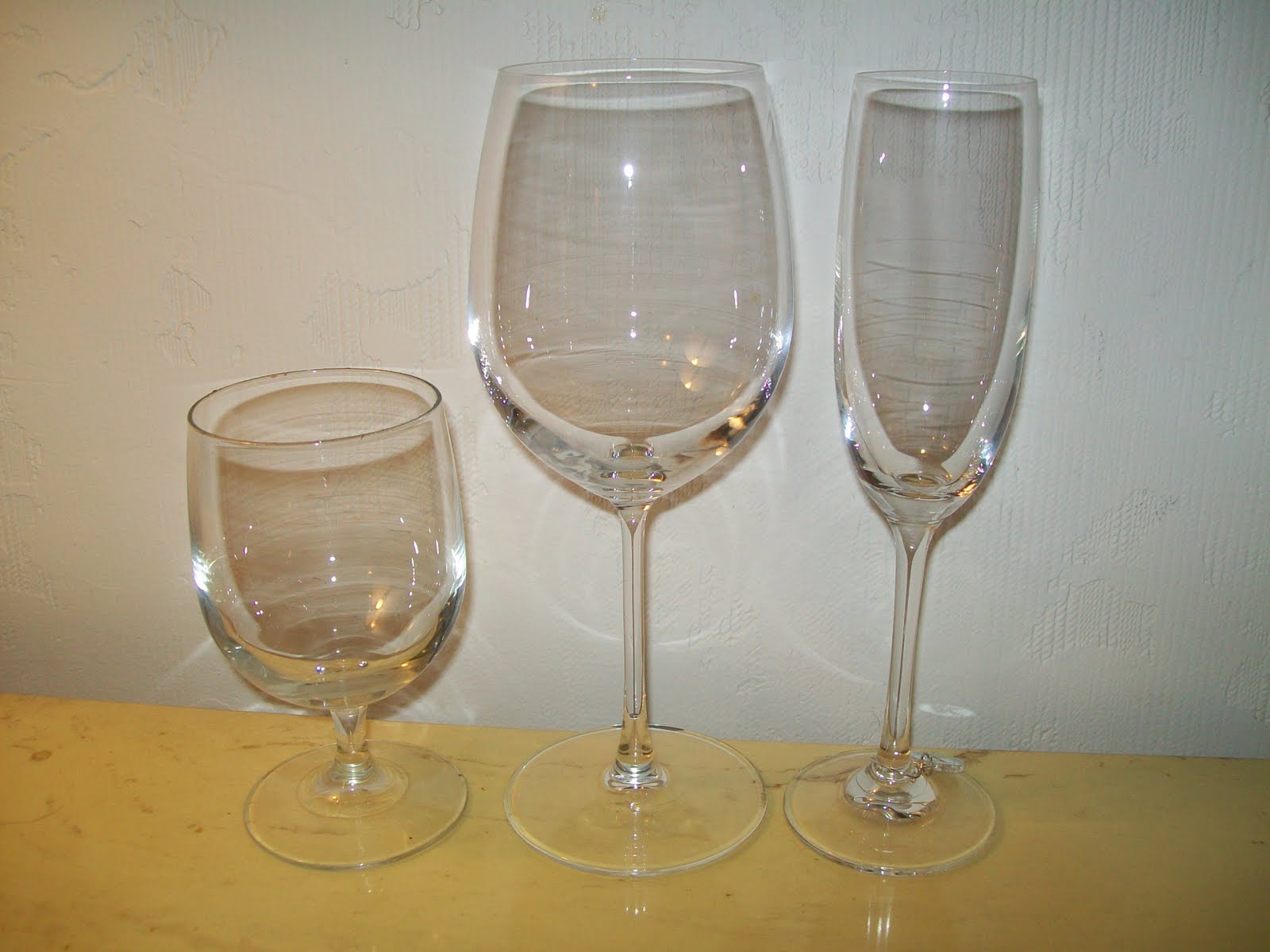
Water glass, (red) wine glass, champaign flute.
Don't even get me started. Check out Riedel glassware for all the different kinds of wine glasses in exsistance, there's too many.

Specialty glasses that don't necessarily have names, but are marketed by companies, in this case Samuel Adams.
Subscribe to:
Posts (Atom)